
Psychology Today referrals dried up for many therapists because telehealth flooded every state directory with hundreds of similar profiles, while venture-backed platforms now compete at the top of Google. The fix is turning your own website into a calm, specialty-specific front door that converts every directory click and earns direct local search traffic.
Five years ago, a decent headshot and a $29.95 listing on Psychology Today could keep a solo caseload full without much thought. You wrote three warm paragraphs, checked fifteen specialty boxes, and answered the phone.
That era is over. Not because people stopped looking for therapy, and not because Psychology Today stopped getting traffic, but because the crowded directory changed how clients decide.
Before blaming the directory alone, see what happens the moment a prospective client clicks from your profile onto your own site. Grade your therapist website free in about a minute.
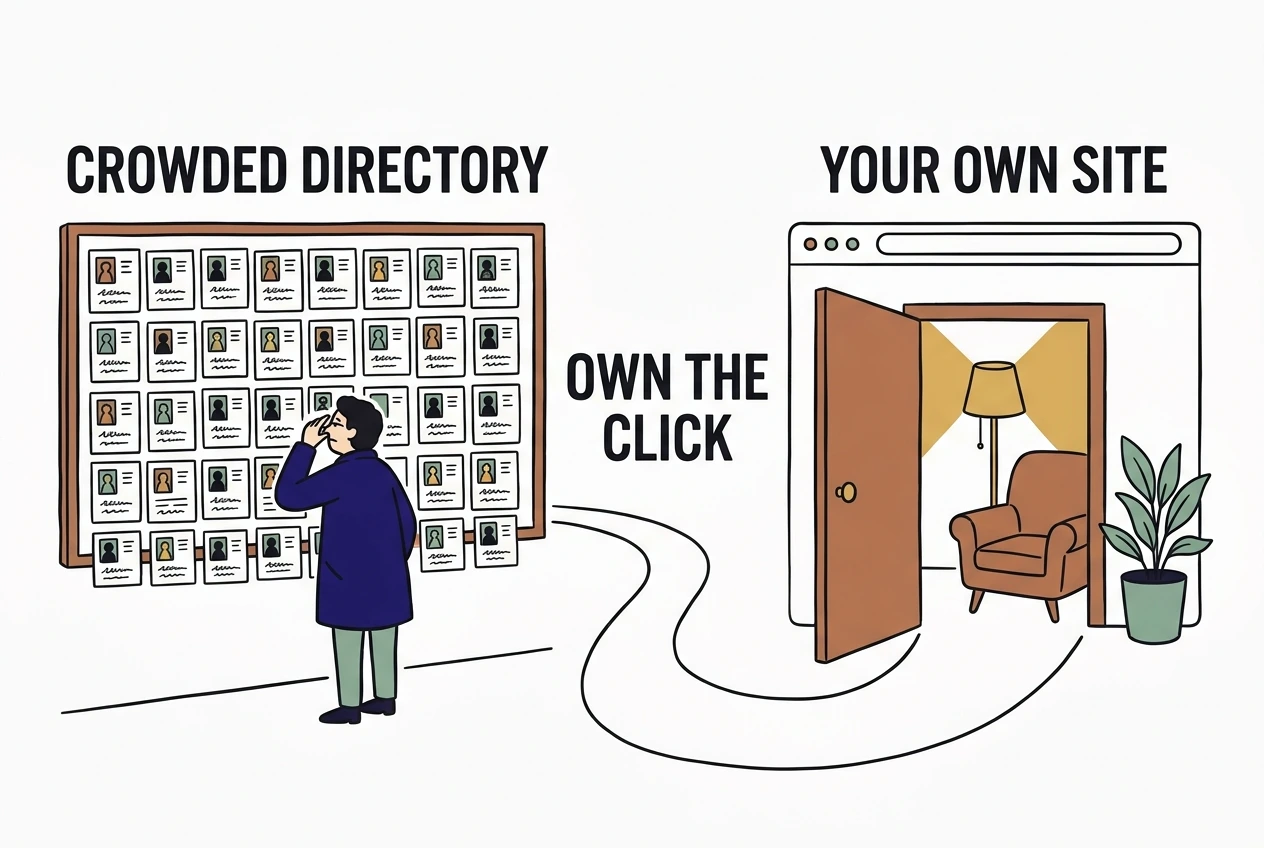
From a crowded directory wall to a calm front door
Why Psychology Today referrals slowed down
Directory inquiries dropped because supply exploded across state lines while prospective clients became more skeptical of generic therapist bios.
When telehealth normalized statewide care, a local client searching your zip code suddenly saw every licensed clinician in the state instead of the twelve offices in town. On Psychology Today, every profile sits in the exact same card template, with the exact same layout and font. When forty clinicians in a row check anxiety, depression, trauma, and life transitions, a nervous client closes the tab instead of messaging anyone.
At the same time, national telehealth platforms and insurance aggregators pour millions into Google Ads above directory results. That means fewer organic clicks reach page two of a directory, and the people who do click your profile immediately tap the website link to verify whether you feel real.
First impressions happen fast. Research in Behaviour and Information Technology established that visitors form a visual impression of a website in about fifty milliseconds. And Stanford web credibility research led by B.J. Fogg noted that "when it comes to Web sites, looking good is often interpreted as being credible."
Psychology Today is still worth keeping at $29.95 a month if one booked client pays for the whole year. The mistake is expecting a directory card to do the trust work your website should own.
Four website fixes that turn quiet weeks into consults
Every practice that stops depending on Psychology Today fixes the same four bottlenecks on its own site.
| Fix | What stalls inquiries today | What converts clients directly |
|---|---|---|
| 1. One clear specialty screen | "Welcome to my practice" plus fifteen unchecked specialties | Exact client focus, city or telehealth state, and one calm CTA above the fold |
| 2. Dedicated specialty pages | One generic Services page trying to rank for everything | Separate pages for anxiety, couples, EMDR, or postpartum care in your city |
| 3. Honest fee and insurance clarity | Blank pricing page or buried paragraph about superbills | Clear session rate, insurance status, superbill steps, and Good Faith Estimate notice |
| 4. One-tap consult booking | Long nine-field form or phone-only voicemail tag | Direct link to SimplePractice, TherapyNotes, Jane, or a short 15-minute call request |
Across the private-practice sites we inspect at Mirin, the biggest hidden drop-off happens between Psychology Today and the therapist's homepage. A client reads a warm directory profile, clicks the website button on their phone at ten at night, and lands on a slow template with stock pebbles and no mention of fees or availability. They hit the back button in ten seconds.
Fix 1 and 2: Lead with your client's words and split your specialty pages
Google and AI search tools rarely rank a generic "Counseling Services" page, while focused specialty pages rank directly for the exact pain a client types.
Start with your opening headline. Drop clinical jargon and write the sentence your best-fit client says in the first five minutes of intake. If you struggle to turn your clinical background into human language, draft a clean homepage opener and Psychology Today bio side by side with our free therapist bio generator.
Next, stop cramming every issue onto one page. Give each core specialty its own page with its own URL, title, and local signal, such as couples therapy in Austin or EMDR trauma therapy across Oregon. That gives Google clear topical relevance so prospective clients find your site directly instead of sorting through forty directory profiles first.
For concrete layout patterns that get this balance right, browse our therapist website examples and read what a therapist website has to do before someone books.
Find out why directory clicks leave before booking a consult.
Paste your practice URL for a plain-English scorecard checking first-screen clarity, fees, EHR handoff, and mobile speed, plus a free rebuilt homepage.
Grade my practice site- Paste your practice URL
- Plain-English scorecard
- Free rebuilt homepage
- Keep your EHR and domain
Fix 3 and 4: Remove fee mystery and booking friction on mobile
Anxious visitors will not email you just to ask what a 50-minute session costs, and they will not fight a slow mobile page to schedule a call.
Put your individual rate, couples rate, sliding-scale policy, and out-of-network superbill instructions in plain sight. Pair them with a clear Good Faith Estimate website notice so self-pay clients feel respected from the first visit. You can also read our full guide on writing a therapist fees and Good Faith Estimate page.
Then test your booking button on your own phone over cellular data. Google mobile speed studies show bounce risk rises sharply when pages take more than a couple of seconds to settle. Your primary button should take a client straight to your SimplePractice, TherapyNotes, Jane, or IntakeQ consult calendar in one tap.
Keep the directory, own the relationship
You do not have to cancel Psychology Today tomorrow. Keep it as a low-cost billboard, and make your own domain the engine that earns Google searches and converts referrals without paying a middleman forever.
If your current practice site feels impossible to update between sessions, see how Mirin approaches websites for therapists, or compare switching options on Mirin vs. Brighter Vision and Mirin vs. SimplePractice.
Turn quiet directory weeks into direct consult bookings.
Paste your current website address. Mirin rebuilds your homepage free from what is live today, usually within hours, while your existing site stays online.
See my free practice redesign- Paste your practice address
- Review your private draft
- Link your EHR and fees
- Publish live on your domain
Directories are rented land. When referrals slow down, the practices that stay booked are the ones whose own websites answer who they help, what sessions cost, and how to book in the first ten seconds.