
An HVAC website can cost less to launch than many owners expect, but the launch price is not the full decision. The real cost includes the work of keeping emergency contact details visible, explaining maintenance agreements clearly, and building useful service pages for every town you serve. In 2026, there is no defensible market average to apply to every HVAC website. Compare the cost structure instead: who pays at launch, who pays afterward, and who owns the work when the site needs attention?
The four common models are a DIY builder, a freelancer, an agency, and a done for you service. Each can be the right answer for a different heating and cooling business. A low starting price may come with more owner time. A higher price may buy strategy or reduce routine work. The useful comparison is not simply what the website costs. It is what staying effective costs after the website is live.
Mirin's public service overview describes the handled website model behind this advice: read the overview.
Why HVAC Website Cost Is Hard To Compare
Two HVAC website quotes can begin at similar prices and still create very different obligations. One may cover a small set of pages and leave you responsible for updates, forms, phone numbers, and service areas. Another may include planning and implementation while requiring a larger payment before launch. The number on the proposal does not describe the owner workload by itself.
For an HVAC business, the important question is what happens after launch. Can a homeowner find the emergency number outside business hours? Can a maintenance prospect understand the agreement without calling to decode it? Can someone in a nearby town find a page that actually speaks to that service area? Those are ongoing website jobs, not merely launch features.
That is why published HVAC pricing is difficult to turn into one honest average. Different sources describe different scopes, levels of customization, and support arrangements. Without a named, current source for a specific range, treat the range as unavailable rather than filling the gap with a market estimate. A quote is useful only when you can see what work it includes and who owns the rest.
A sound comparison separates two bills. The launch payment covers planning, design, writing, setup, and the first set of pages. The ongoing payment covers a platform, hosting, support, maintenance, or your own time. Some models make the second bill visible in dollars. Others hide it in evenings spent editing pages, chasing fixes, or waiting for help. Both are costs.
For HVAC contractors, the decision is therefore practical. Choose the arrangement that gives someone reliable ownership of urgent call visibility, maintenance plan messaging, and town specific service coverage. If nobody has that responsibility, even a polished launch can become an expensive starting point rather than a useful working asset.
When the decision reaches budget and scope, compare Mirin's current service options and pricing.
Before comparing prices, write down the work your site must keep doing. List your emergency number, core heating and cooling services, maintenance offer, service towns, financing or trust information, and the changes that happen during a busy season. That list turns a vague website quote into a more useful ownership question.
Four HVAC Website Models And Their Costs
A DIY builder usually has the clearest platform price and the lowest cash cost at launch. The owner chooses a template, writes or supplies the content, creates the pages, and handles later changes. The recurring platform price is published by the chosen provider on its own site. The honest cost is therefore the provider price plus your time and any outside help.
DIY suits an owner who is comfortable making edits, has a contained service area, and can protect time for the website. It offers direct control and a fast way to publish a basic presence. It becomes less comfortable when every town needs a useful page, several services need distinct explanations, or the owner is already the dispatcher, estimator, and field supervisor. The model is legitimate, but only when the work has a real owner.
A freelancer commonly charges an initial project fee based on page count, writing, design, technical setup, and revision time. Recurring maintenance may be separate, included for a period, or unavailable as a published range. A freelancer's number only means something beside a written scope. This model can suit an HVAC company that wants tailored work, has a clear brief, and can manage an ongoing relationship after launch.
A freelancer may give you more direct collaboration and control than a packaged service. You may also get a stronger fit for unusual service information or a carefully planned set of town pages. The tradeoff is continuity. Ask who changes a seasonal offer, fixes a broken form, updates a service area, and checks the mobile emergency contact when the original project is finished. Those questions belong in the cost comparison.
An agency usually carries the largest planning and production scope of the four models, but the price depends heavily on strategy, design depth, integrations, copy, photography, and the number of pages. No single agency market range exists, so do not treat a published figure from another industry as an HVAC average. Agency work suits businesses with a larger brief, complex requirements, or an internal person ready to manage the project.
An agency can be the right choice when you need custom functionality, several systems connected, extensive content planning, or deep control over the finished website. It can be the wrong choice when the business mainly needs a clear service site that stays current without a long internal project. The relevant question is not whether agency work is better. It is whether the added scope solves a real business requirement.
The Deciding Variable Is Ongoing Website Ownership
The deciding variable is who will reliably maintain revenue critical website work after launch. A platform can provide a phone button, forms, page templates, and space for service information. It cannot decide whether the emergency number is still correct, whether the maintenance agreement is explained plainly, or whether a new town deserves its own useful page. Features create capacity. Ownership turns that capacity into working information.
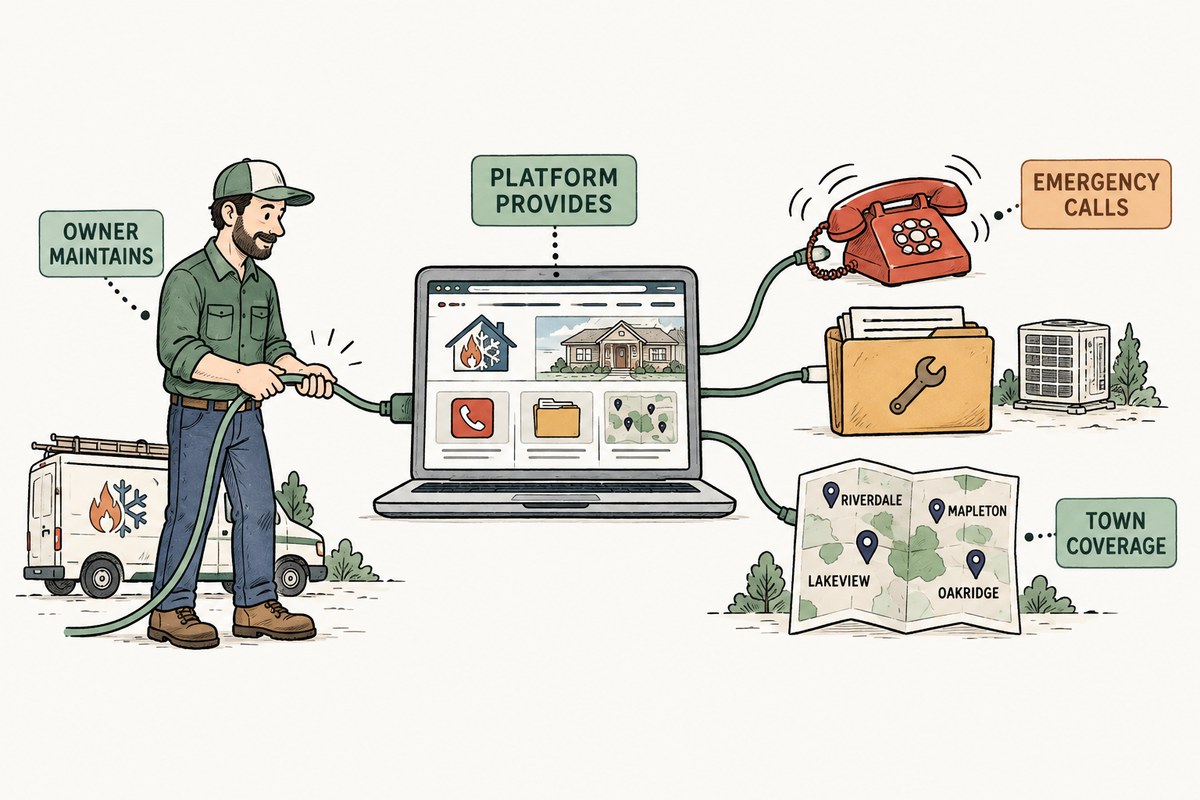
Test each model against the three jobs your HVAC website has to support. For after hours calls, someone must keep the emergency route obvious and accurate. For maintenance agreements, someone must explain what the plan is, who it suits, and what the next step means. For town coverage, someone must create pages with real local relevance instead of copying one paragraph and changing a place name. how to write a service page that converts covers what a strong page contains.
A DIY builder assigns that work to you or your team. A freelancer may do it if the arrangement includes ongoing support, but that must be agreed rather than assumed. An agency may assign it through a retainer or a new project. A done for you service is designed around reducing routine owner involvement, but the exact included work, price, page limits, and hosting terms must be checked against its current public offer.
This distinction also explains why a lower launch payment is not automatically cheaper. If a site saves money at launch but leaves the owner with every update, its ongoing cost is measured in attention and delay. If a higher launch payment removes unnecessary work but does not fit the required functionality, it may still be poor value. Ownership is the variable that connects price to daily reality.
The most useful proposal names responsibility, not just deliverables. Look for language that answers who writes, publishes, checks, and maintains each critical item. If the answer is always the owner, price the work honestly as part of the model. If another party owns it, confirm the boundary, response expectations, and recurring cost before choosing.
The broader decision framework is explained in Mirin's small business website approach.
An HVAC website is not finished when its pages first appear. It is working when the information a caller needs remains easy to find and the pages still reflect the services and places the business actually serves. The model that makes that upkeep dependable deserves more weight than a launch price considered alone.
Choosing Wrong Creates Different HVAC Costs
Choosing DIY when you have no protected time can turn ordinary website upkeep into a recurring interruption. The financial cost may be modest at first, while the operational cost appears as outdated service information, unfinished pages, or a form nobody checks. DIY is not inherently cheap if the owner cannot consistently do the work it requires.
Choosing a freelancer can be sensible when you want tailored work and can maintain a productive relationship. The mismatch appears when you assume the project fee includes indefinite support. A strong freelancer fit still needs a clear arrangement for edits, new towns, seasonal services, broken forms, and urgent corrections. Without that arrangement, the site may depend on a person who has moved to another project.
An agency can fit a complex website, a demanding brand, custom integrations, or a business with someone available to manage a substantial project. The cost can become disproportionate when the brief is simple but the process is broad. You may pay for planning and control that your business does not need, while still needing to budget separately for ongoing content changes.
A done for you service can reduce routine website ownership when the offer genuinely includes the pages and handling your business needs. It may be a poor fit for unusual functionality, extensive custom development, or a team that wants deep control over every implementation choice. The financial cost is only one side. The operational cost is the work created by a mismatch between the service and your preferred way of operating.
The safest comparison asks what failure looks like for each model. With DIY, it may be neglected updates. With a freelancer, it may be unclear follow through after launch. With an agency, it may be unnecessary scope or a longer process. With a done for you service, it may be limited flexibility. None of these outcomes is universal. They are warning signs to test against your own business.
Do not use promised results to settle the choice. No evidence proves that one model catches more emergency calls, sells more maintenance agreements, or produces more town based traffic. The responsible decision is operational: choose the arrangement that makes the required work likely to happen, then judge performance using your own call and inquiry evidence.
Find Your Side Of The Website Cost Line
DIY is the right answer when you have the time, confidence, and discipline to own edits yourself. It fits a contained service area, a modest page set, and an owner or employee who can keep emergency information, service descriptions, and seasonal details current. Choose it because you can do the work consistently, not merely because the platform price looks low.
A freelancer is the right answer when you want a tailored website, can supply a clear brief, and either have internal marketing skills or are willing to arrange ongoing help. This model fits an HVAC company with a defined content plan, a manageable number of services and towns, and a preference for direct control. Confirm the maintenance relationship before signing the launch project.
An agency is the right answer when you need custom integrations, a complex information structure, extensive strategy, or a team that wants a high degree of control. It is also reasonable when the website is part of a broader marketing operation with people available to manage approvals and ongoing work. If your needs are straightforward, ask whether that complexity earns its place in the budget.
A done for you service is the right answer when your main constraint is owner attention. It fits a business that wants a credible website kept useful without turning publishing into another job, provided the public offer covers the pages, support, hosting, and changes you need. Check the current offer rather than relying on a remembered price or an assumption about page limits.
For the operating model behind that work, explore how Mirin plans, builds, and maintains websites.
Now score your situation honestly. How much time can someone protect each month? How many services and towns need distinct coverage? How often do urgent calls matter? How important are maintenance agreements to the sales conversation? Do you have marketing skills in house? Do you need custom integrations or deep control? The answers matter more than the label attached to the website model.
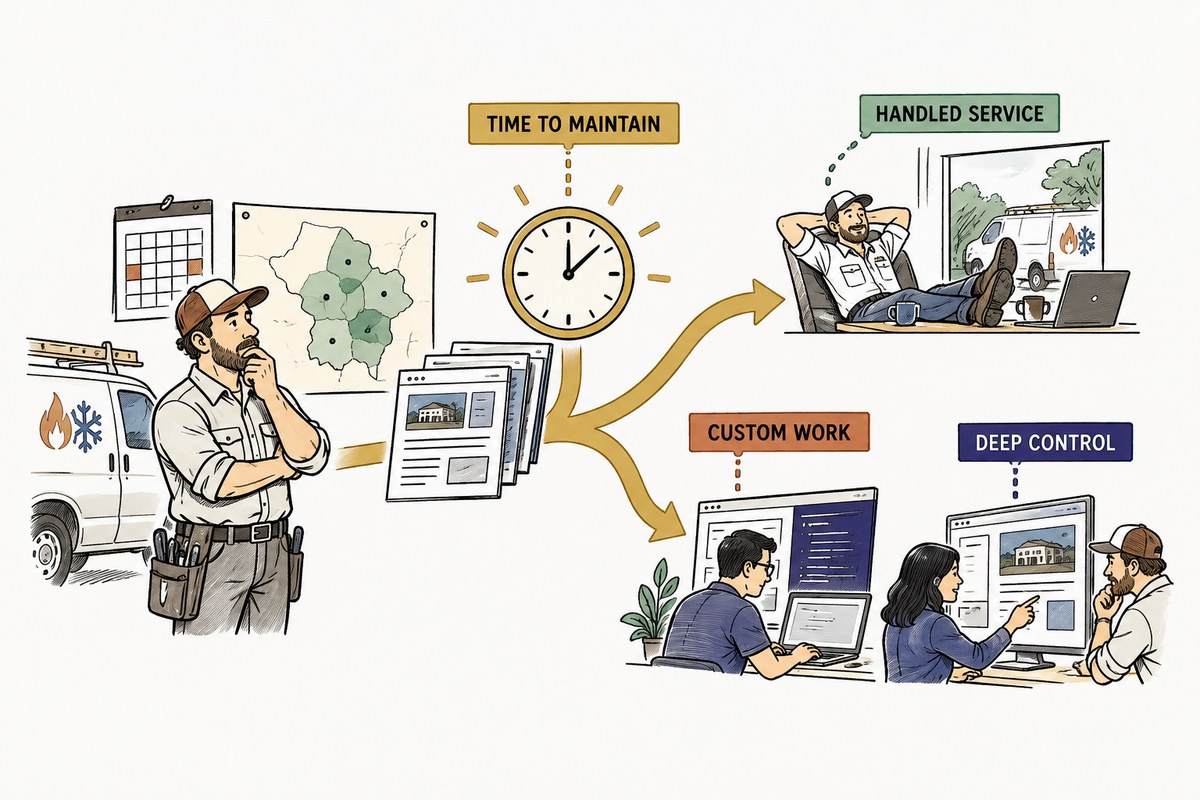
If those answers point to ongoing handling rather than a dashboard you want to manage, review Mirin's current managed website offer and ask Mirin for a finished website before deciding. If they point to custom development, unusual integrations, or full implementation control, choose a freelancer or agency instead. That is not a failure of the managed model. It is the point of making the fit explicit.
Make The Website Decision With Confidence
The decision rule is simple: choose the model that matches the work someone will consistently own after launch. Choose DIY when you have time and a contained brief. Choose a freelancer when you want tailored work and can arrange continuity. Choose an agency when custom scope and control justify a larger project. Choose done for you when reducing routine ownership is the main requirement.
For an HVAC owner, the test is concrete. Can the emergency route stay visible after hours? Can a homeowner understand the maintenance agreement? Can a searcher in each served town find useful, specific information? The best model is the one that gives those jobs a named owner without creating work your business will repeatedly postpone.
Keep launch and ongoing cost separate when comparing proposals. Ask what is included at the beginning, what recurs afterward, and what happens when you need another service page, a new town, a changed offer, or a correction on a live page. If a cost cannot be supported by a current named public source, label it unavailable rather than calling it a market average.
There is no single source for a universal HVAC website price, and one should not be invented here. The meaningful answer depends on scope, control, support, and the work your business must keep doing. Read the current public offer for any managed option, compare it with the responsibility you can actually carry, and make the decision from that fit.
A website quote answers what someone will build. A good website decision also answers who will keep it useful when the season changes, the service area grows, or a caller needs help at an inconvenient hour. Price that responsibility plainly, and the four options become easier to compare without pretending that one model suits every HVAC company.
For the broader trades picture, the contractor website cost guide walks the same decision for general contractors. Cost decisions in nearby local service trades follow the same shape: the salon website cost guide and the med spa website cost guide price their own four models the same way. The Mirin Journal's website strategy library keeps going from there.
The next step is not to find the cheapest launch number. It is to identify the website work your business cannot afford to leave unattended, then select the model whose cost structure gives that work a dependable owner.