
A plumber website can cost very little to launch and still cost you later in missed updates, owner time, or repeated requests to someone who is hard to reach. The honest 2026 answer is not one universal price. Separate the launch price, recurring platform cost, update labor, and risk of stale information. Then ask the question that makes the options comparable: who will keep your emergency hours, service areas, credentials, and seasonal offers current after launch?
DIY builders, freelancers, agencies, and done for you services can all be sensible choices. The right answer depends less on the first invoice than on the work your business can reliably absorb after launch. A small plumbing company that wants full control may prefer a builder. An owner who wants the site handled may value a managed workflow. Neither choice is automatically cheaper or better.
Mirin's public service overview describes the handled website model behind this advice: read the overview.
Why Plumber Website Prices Are Hard To Compare
When a plumber asks what a website costs, four different expenses are usually mixed together. There is the work to create the site, the recurring platform or hosting cost, the labor required for later changes, and the business cost of information being wrong. A low launch quote may cover only the first item.
That is why price categories need clear labels. A builder usually presents a recurring subscription and asks you to do the setup. A freelancer may quote a project and bill later changes separately. An agency may combine strategy, design, marketing, and technical work. A done for you service may package the website and an ongoing workflow differently.
None of these structures is automatically misleading. They simply move responsibility around. You might pay less in cash but spend more of your own time. You might pay more for broader expertise than a simple site needs. You might choose a service because the work of keeping the site current matters more than having complete control over every part of it.
When the decision reaches budget and scope, compare Mirin's current service options and pricing.
For a plumbing business, current information is unusually practical. Emergency hours can change. A new service area may need to appear before the next job. License and insurance details need attention when they expire or renew. Seasonal offers have a useful window. The cost decision should account for who notices and handles those changes, not just who builds the pages.
Compare Four Ways To Build A Website
A DIY builder is usually the clearest fit when you want direct control, enjoy working in the site, and can give updates a regular place on your calendar. You choose the structure, edit the words, and accept responsibility for quality checks. Its cost structure is often a recurring platform charge plus your time, with optional paid help if you get stuck.
A freelancer is sensible when you want a tailored site but only expect occasional changes, and you already know a trusted person who will remain available. The cost is commonly a project fee followed by separately agreed update work. You gain personal attention without paying for a full agency relationship, but availability and ownership need to be written down.
An agency can be the right answer for a larger plumbing business with several teams, broad marketing goals, complex integrations, or a need for ongoing strategy. You are paying for a wider set of skills and coordination, not simply a few page edits. That depth can be valuable when the website is part of a larger growth system.
For the operating model behind that work, explore how Mirin plans, builds, and maintains websites.
A done for you website is different from both a builder and a traditional agency. It fits an owner who wants the website handled while retaining a simple way to request ordinary changes. It may be the wrong answer if you want to control every layout decision or need advanced marketing and integration work. The point is reduced owner effort, not universal superiority.
Website Update Ownership Sets The Real Cost
The deciding variable is update ownership. Ask who changes the emergency hours when the phone line is covered differently, who adds a new service area, who replaces an outdated license or insurance detail, and who publishes a seasonal offer. Then ask how that person receives the request and how you know the change is complete.
With a DIY builder, you own the edit from beginning to end. That gives you control and can be efficient when you are comfortable with the tool. It also means the update waits for you. During a busy week, the website may remain unchanged not because the edit is difficult, but because nobody else is responsible for doing it.
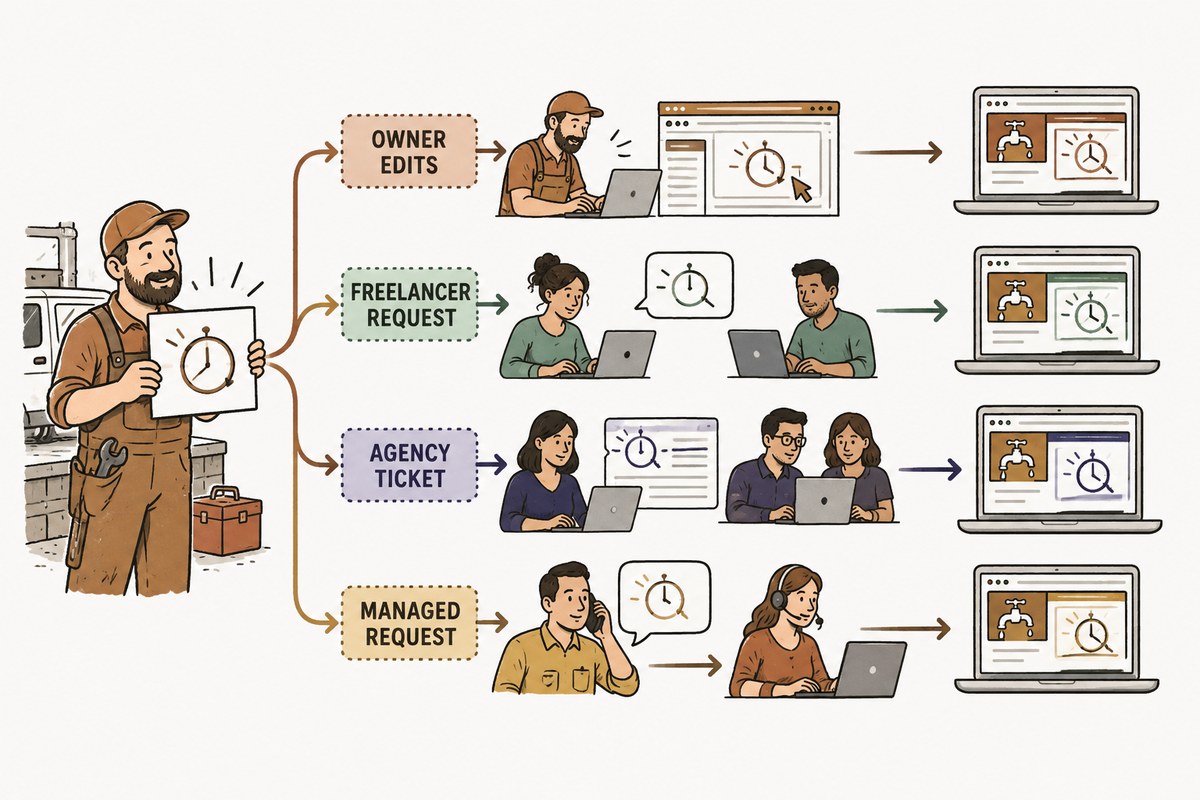
With a freelancer, you usually send the change to a particular person. That can work well when the relationship is dependable and the request is occasional. The open question is availability. Clarify whether small updates are included, billed separately, or handled under a maintenance arrangement before assuming the original project quote covers them.
With an agency, updates may move through a ticket, account contact, or broader marketing process. That structure can be useful when changes connect to campaigns, search work, tracking, or multiple locations. It can also be more process than you need for a phone number or a new weekend emergency schedule. Ask what kinds of edits the relationship is designed to handle.
Wrong Ownership Creates Expensive Gaps
The wrong model does not always fail at launch. It fails when the business changes and the website does not. A DIY choice can become a poor fit when the owner understands the editor but cannot reliably make time for it. The site remains technically under control while practical responsibility disappears into the week.
A freelancer can be an excellent choice for a focused project and occasional work. The risk is a dependency without a clear agreement. If only one person knows the site and nobody has confirmed their availability, a simple change can become a search for the original contact. The issue is not freelance work itself. It is undefined ownership.
An agency brings useful depth when you need strategy, content, marketing coordination, or technical work beyond ordinary edits. It may be excessive for a small site whose main needs are accurate hours, services, areas, and contact details. Paying for capability you do not use is a different kind of mismatch from paying too little.
A done for you model can also be wrong. If you want to experiment with layouts, manage every page, or connect unusual systems yourself, a managed workflow may feel restrictive. Its value depends on wanting the responsibility handled while keeping a straightforward way to request changes. Control and convenience are both valid priorities, but they are not the same priority.
Match Your Business To The Right Option
Start with update frequency. If your hours, service areas, credentials, and offers rarely change, occasional help may be enough. If those details change with the season, staffing, geography, or promotions, choose a setup with a clear repeatable way to keep them accurate. Frequency does not decide everything, but it exposes weak ownership quickly.
Next, assess your working preference. Choose DIY if you are comfortable editing and willing to maintain the site. Consider a freelancer if you want occasional personal help and have a trusted person to call. Consider an agency if marketing complexity, multiple locations, integrations, or broader technical needs justify a larger relationship.
A done for you option deserves consideration when your main requirement is that the website not become another job, while you still want to request changes in plain language. That is the fit Mirin is designed to explore. If you want a finished website you can change by typing a sentence, you can ask Mirin whether that workflow suits your business.
For more practical context, continue with the Mirin Journal's website strategy library.
Before paying anyone, ask about recurring costs, edit fees, domain ownership, content ownership, expected turnaround, emergency changes, credential updates, and seasonal promotions. Ask for the answer in writing. If you need complete control, choose the builder or arrangement that gives you that control. If you need complex marketing strategy, choose the agency that can provide it.
Choose The Website Model You Can Maintain
The decision can be made with a simple fit test. Choose DIY when you are willing to maintain the site and want direct control. Choose a freelancer when the need is occasional and a trusted person is genuinely available. Choose an agency when the website needs broader ongoing marketing, integrations, or technical coordination.
Choose done for you when you want the website handled and still want a simple request based way to make ordinary changes. That can be a strong fit for an owner who does not want a dashboard to become another responsibility. It is not the right fit for someone who wants unrestricted control over every design and technical decision.
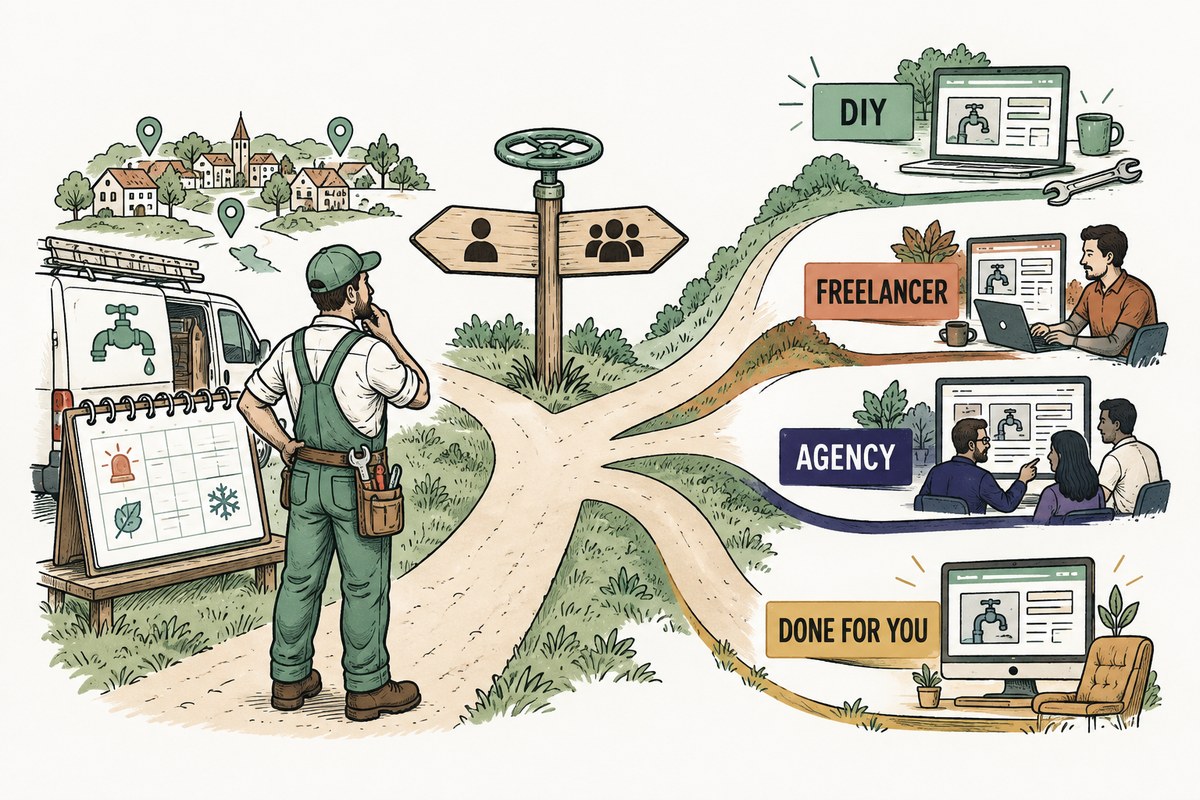
Before comparing quotes, write down the updates your business actually makes: emergency hours, service areas, license and insurance details, service descriptions, phone numbers, and seasonal offers. For each one, name the person who would make the change. If you cannot name that person, the quote is missing an important part of the cost.
The broader decision framework is explained in Mirin's small business website approach.
The lowest launch price is therefore not necessarily the lowest cost. A cheap site that nobody updates can create an information gap. A larger relationship can be wasteful when your needs are simple. The best model is the one whose post launch responsibility matches your time, comfort, business complexity, and need for control.