
A roofer website costs $2,900 to $8,700 in the United States with a freelancer and $7,250 to $21,750 with an agency in 2026, and a typical roofing build lands near $5,800, according to Project Cost Estimator’s Roofer Website Cost 2026, updated July 2026. A do it yourself site costs your time instead of a project fee, and a monthly done for you service has no single published market average. The price depends on the route, and the decision that matters is who keeps the site accurate after launch.
For a roofer, maintenance means more than changing a phone number. It can mean updating a storm response page, adding a completed roof to a gallery, revising towns served, checking a quote request form, or keeping financing and certification information current. A lower launch price is only useful when someone reliable can still do that work. Your route should match the person who owns those changes.
Mirin's public service overview describes the handled website model behind this advice: read the overview.
What a Roofer Website Costs in 2026
The honest price answer has four parts: do it yourself, freelancer, agency, and monthly done for you service. These are different ways of paying for website work, not interchangeable line items. Project Cost Estimator’s Roofer Website Cost 2026, updated July 2026 and based on more than 600 project quotes and rate benchmarks, puts a United States freelancer build at $2,900 to $8,700 and an agency build at $7,250 to $21,750 for the same roofing scope.
Those are figures from one named, dated source, not a market average for every roofing website, and a careful buyer should treat them that way. The same source puts monthly running costs at $35 to $180 for hosting, tools and maintenance. It also names what moves the number: a financing plus instant estimate embed typically adds $500 to $1,500, and a structured before and after gallery adds $300 to $800. Where no named source publishes a number, this article says so instead of inventing a range.
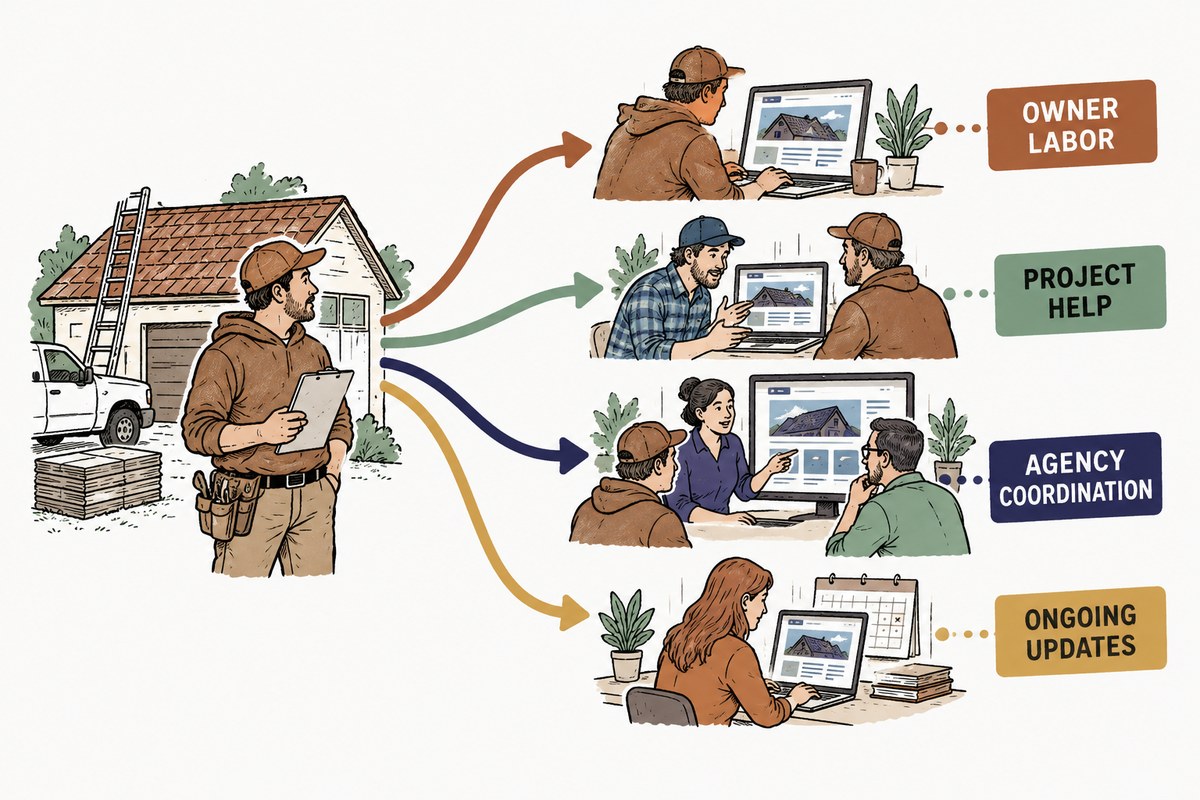
The same caution applies to monthly done for you pricing. A recurring service is priced differently from a one time project, and no named source publishes a market average for that category. Providers quote it against a stated scope of updates, so compare what each plan includes rather than a headline number.
When the decision reaches budget and scope, compare Mirin's current service options and pricing.
So what does a roofing company pay? With a freelancer, $2,900 to $8,700 in the published 2026 figures. With an agency, $7,250 to $21,750. With do it yourself, your own time and a builder subscription. With a monthly service, a recurring fee against a stated scope. The route decides the work as much as the price, and the sections that follow help you pick one you can keep up.
Four Ways to Build a Roofing Website
Do it yourself is a sensible route when the owner genuinely wants control, has time to write and publish, and can handle ordinary fixes without waiting for another person. It can suit a small service area, a straightforward quote path, and a roofer who would rather trade time for control than pay for continuing help.
A freelancer is often a good fit when the project has a clear boundary and someone inside the company can handle routine edits afterward. A freelancer may build the pages, gallery, form, and service area structure, then hand them over. Ask whether later support is included, optional, or entirely separate before comparing the project price.
Other local service businesses face the same four routes, and the contractor website cost guide and the small business website cost guide price them for those readers.
An agency can make sense when the website sits inside a broader marketing operation. An agency may coordinate content, search work, paid campaigns, photography, or several locations. That wider support can justify more coordination for a roofing company with a large service area or an internal marketing process.
For the operating model behind that work, explore how Mirin plans, builds, and maintains websites.
A monthly done for you service is different from both project work and self management. The purchase is not only a new website. It is an ongoing arrangement for having website work handled. Scope varies by provider, so ask who makes changes, what counts as an update, and how urgent requests are handled. Do not assume every monthly plan includes every page or campaign. The route is only clear when those boundaries are clear.
Roofing Website Cost Depends on Update Ownership
Roofing creates continuing website work that a simple brochure site may not. A roof quote or instant estimate request form needs to remain usable. A before and after gallery needs new proof. Storm damage and insurance claim help content needs review. Financing information and manufacturer certification badges need a clear owner.
Service area pages add another responsibility. If you serve several towns, each page needs accurate locations, services, and proof rather than a copied place name. The number of towns does not automatically determine the price, and no named source publishes a market average for that work. It does show why a feature list is not a maintenance plan.
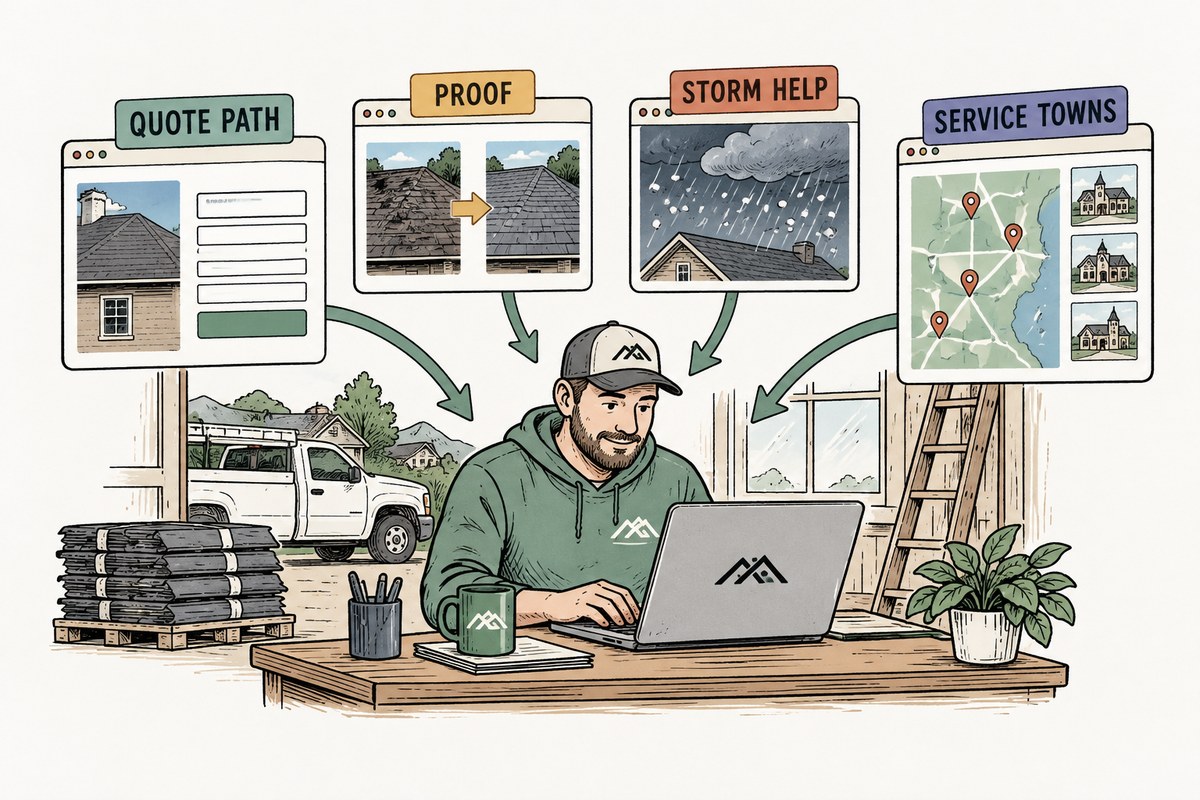
The deciding variable is the speed and reliability of accurate changes after launch. Can the owner publish a new hail response page? Can a staff member replace an outdated badge? Can a freelancer respond when a form needs changing? Can an agency coordinate those tasks without creating another administrative burden? Those questions often explain the right route better than a page count.
For more practical context, continue with the Mirin Journal's website strategy library.
A website with more features is not automatically more expensive in a useful sense, and a simpler website is not automatically easier to keep current. A form can be simple to use but important to test. A gallery can be easy to add to but easy to neglect. The cost is shaped by both the work itself and the person responsible for completing it. That is why two roofing sites with similar page lists can be very different purchases.
The Wrong Website Route Creates More Work
The cheapest launch route can become the most demanding route when the owner is the only editor. Roofing work is seasonal, weather driven, and often urgent. If the site depends on the owner remembering every update between estimates, crews, suppliers, and customers, stale content becomes a predictable operating problem rather than a surprising failure.
A freelancer can avoid that burden when the agreement covers the changes you actually need. It can also create friction when every small request depends on one person’s availability. The answer is not to distrust freelancers. Ask whether the arrangement includes a dependable update process, a clear boundary, and a named person on both sides who knows what happens after launch.
An agency may be excessive for a smaller roofer who needs a credible website and occasional edits. It may be reasonable for a larger company managing several towns, campaigns, content streams, and providers. The question is whether you need broader coordination, not whether agencies are inherently better or worse. A larger process should solve a larger operating problem.
The broader decision framework is explained in Mirin's small business website approach.
A monthly managed route can also be the wrong fit. An owner who wants full control may prefer self management. A roofer with a dependable in house editor may not need another party involved. A monthly service makes more sense when the recurring responsibility is the problem and the owner wants a clear way to have updates handled without learning another publishing system or remembering every seasonal change.
How to Know Which Route Fits
Start with the person who will make the next important change, not the person who will approve the homepage. List your service towns, quote process, seasonal content needs, and appetite for control. Then ask whether that person has time to publish accurately when roofing work becomes busy. This reveals the operating fit before the design discussion takes over.
The same choice shows up in other local service businesses, and the salon website cost guide and the med spa website cost guide price the same four routes for those industries.
Self management fits when you will genuinely maintain the site, your service area is manageable, and your quote path does not require frequent outside changes. A freelancer fits when you can define the build clearly and have an owner or staff editor available. Both are sensible when control and project boundaries matter more than handoff convenience.
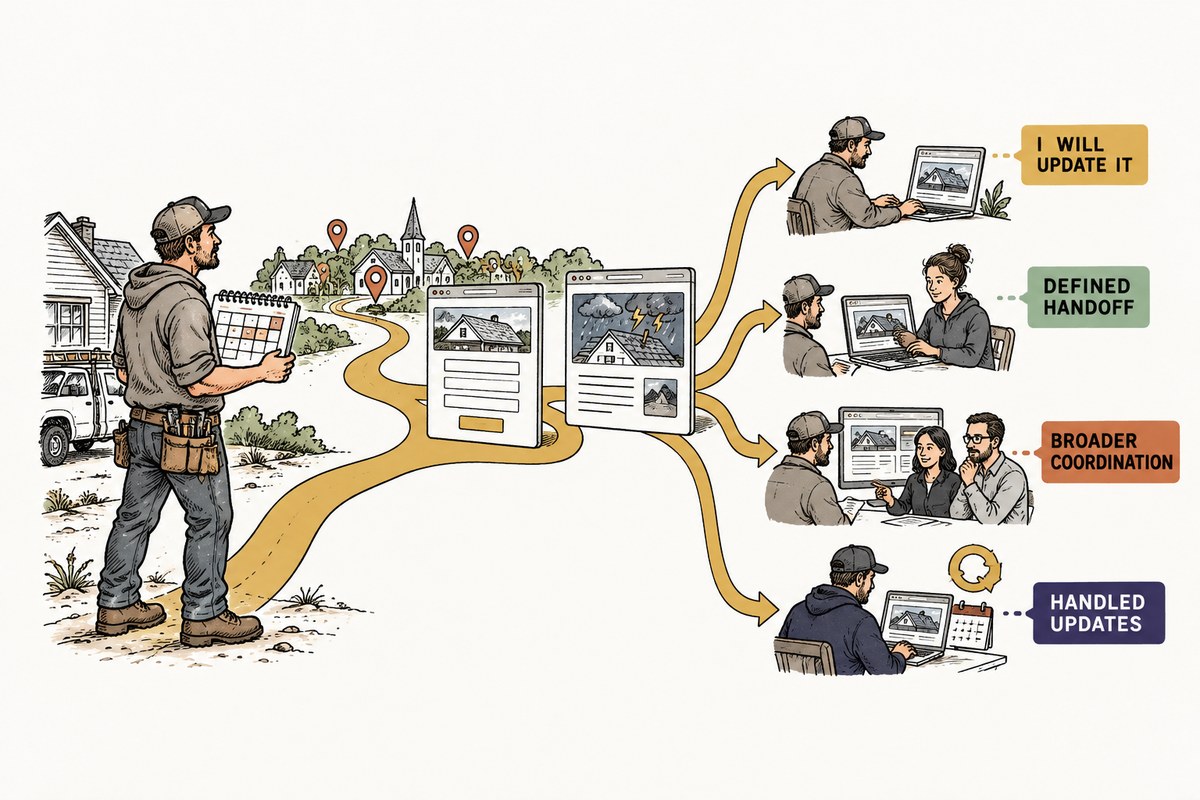
An agency fits when you need broader marketing coordination, more complex content, or support across a larger operation. It is less compelling when the main problem is simply having a dependable person update a few roofing pages. Match the scope you need rather than buying a larger process because the word agency sounds comprehensive.
A monthly done for you service fits when ongoing responsibility is the deciding problem. Before choosing it, ask who updates storm damage and insurance claim help content, who maintains service area pages, who checks the estimate form, and what happens when a change is time sensitive. If those answers remain vague, the route is not defined well enough to buy. The best price comparison names the work as well as the payment model.
Who Owns Storm Updates After Launch
Storm season and hail response pages are not launch content that can be forgotten. They should be reviewed twice a year as recurring operating work, then changed whenever the company’s response, service area, financing information, or insurance guidance changes. The point is not a universal calendar. The point is assigning responsibility before bad weather creates urgency.
The same owner should know who adds a completed roof to the gallery, checks the roof quote or instant estimate form, updates manufacturer certification badges, and corrects a town page. Those tasks may be handled by the owner, staff, freelancer, agency, or monthly provider. What matters is that the handoff is real, understood, and easy to use.
If the owner is responsible, the website needs a publishing setup that does not turn every update into a technical project. If a freelancer is responsible, the agreement needs a clear response process. If an agency is responsible, the company needs one person who can request and approve changes. If a monthly service is responsible, the plan needs to state what is included.
This is also where a low launch price can mislead. A site may look complete on launch day while leaving nobody responsible for the next storm page or the next service town. Ask for the update workflow in plain language. Who receives the request, who makes the change, who checks it, and how quickly does the owner know it is live? Those answers belong in the buying decision, not in a vague promise of support. The route you can maintain is the route you can price honestly.