
A marriage and family therapist website in 2026 can cost about $228 to $747 in the first year when you build it yourself, $69 to $349 a month on a template subscription, $2,900 to $8,700 as a one time freelancer build or $7,250 to $20,300 from an agency in the US, or $99 to $199 a month on a managed website with no setup fee (CoralEHR, checked November 2, 2026; Project Cost Estimator, updated July 2026; Mirin pricing read November 24, 2026). The more useful question is what that price must support. A couples and family practice may need to explain several kinds of care, welcome more than one person into the first enquiry, and keep fees, availability, formats, and intake instructions accurate.
That makes the decision less about buying pages and more about buying a workable explanation of the practice. A simple solo practice with one service and an external booking system can sensibly choose a light route. A practice with several clinicians, discernment counseling, co parenting work, different session formats, and frequent changes may pay less at launch and more later if the structure is difficult to maintain. The deciding variable is practice complexity, not therapist title alone.
Mirin's public service overview describes the handled website model behind this advice: read the overview.
The real decision is cost versus practice fit
The shortest honest answer names the routes, because each publishes a different kind of price. A builder subscription bills monthly and leaves the work with you. A template subscription or a managed website bills monthly and moves some of the work into the service. A freelancer or agency quotes once for the build and prices upkeep separately, if at all. Check each provider before comparing totals, then ask what work the quoted amount actually includes.
A marriage and family therapist is not usually explaining one appointment for one person. The site may need to distinguish couples therapy from family therapy, discernment counseling, co parenting support, and individual work connected to a relationship. It may also need to describe online sessions, in person sessions, consultation, or different starting points without making the visitor decode the practice.
The first enquiry creates another layer. One person may be writing for a couple, a parent may be asking about a family, or two partners may need to understand who should contact the practice. That does not automatically require separate forms. It does require a deliberate decision about what information the website collects and where the enquiry goes next.
So compare the cost of the build with the cost of keeping the explanation clear. A low price is sensible when the practice is simple and stable. It is less attractive when every change requires a technical favor, when service pages blur together, or when the owner has to remember which version of the intake instructions appears on each page.
The best estimate starts with a small inventory: services, clinicians, session formats, enquiry destinations, and pages that change. That inventory gives a freelancer or agency a real scope and gives a therapist evaluating a managed route something concrete to compare. Without it, a low quote may simply be missing the work.
When the decision reaches budget and scope, compare Mirin's current service options and pricing.
A therapist should also separate website work from clinical and administrative systems. A website can explain the first step and send people to an external destination, but the practice must decide what information belongs in that destination. The website price should not be treated as a shortcut around that judgment.
Four website routes suit different practices
DIY is the lowest involvement in money paid to another person, but the highest involvement for the owner. It can be the right answer for a solo therapist with a narrow service list, strong comfort with writing and editing, and an intake or booking system already chosen. Doing it yourself on Squarespace costs about $228 to $747 in the first year once a template is counted (CoralEHR, checked November 2, 2026), on a Basic plan at $19 a month billed yearly or $25 billed month to month (Squarespace pricing read November 24, 2026). The owner controls every change and accepts responsibility for structure, presentation, and upkeep.
A freelancer is often the practical middle ground. One person can shape the pages, write or refine the message, and connect the site to an existing enquiry or booking destination. This is a sensible route when the practice needs thoughtful service pages but not a complex system. Published 2026 numbers differ by source: Project Cost Estimator puts a freelancer build for a therapy practice at $2,900 to $8,700 in the US (updated July 2026), Aman Web Solution's October 2026 budget guide puts a freelancer WordPress build at $1,500 to $4,500, and across therapist designers who publish prices the median build was $3,000, or $3,900 when the designer also writes the words (CoralEHR, checked November 2, 2026). After launch, confirm who owns the account, handles edits, and fixes problems.
An agency is appropriate when the practice needs custom integrations, unusual workflows, several contributors, or a broader discovery process. That can be the right answer even when the practice is small if the intake journey, scheduling arrangement, or internal handoff is genuinely unusual. The tradeoff is a larger project scope and a need to manage the relationship after launch. For the same therapy practice scope, an agency build runs $7,250 to $20,300 in the US (Project Cost Estimator, updated July 2026), and Aman Web Solution's October 2026 guide budgets $5,000 to $15,000 or more for a custom agency or developer build.
A done for you route reduces the owner’s publishing burden by making ongoing website work part of the service. It suits a therapist who wants the practice information kept current without learning a dashboard or coordinating a developer for every adjustment. Ask what is included, how requests are made, what the owner owns, and what happens if the service ends. Template subscriptions such as Brighter Vision and TherapySites run $69 to $349 a month with setup fees on some plans, while a managed website runs $99 or $199 a month with no setup fee, a first year cost of $1,188 to $2,388 (CoralEHR, checked November 2, 2026; Mirin pricing read November 24, 2026).

Every route leaves someone responsible after launch. DIY leaves that work with the therapist. A freelancer may leave a usable site but charge separately for updates. An agency may offer maintenance under a separate arrangement. A managed service takes on more routine responsibility, while the therapist still has to provide accurate changes and approve clinical wording. Upkeep is a real line on every route: $30 to $150 a month for hosting, tools and maintenance (Project Cost Estimator, updated July 2026), or $500 to $2,000 a year to keep a small practice site healthy (Aman Web Solution, October 2026).
There is no virtue in choosing the most managed route by default. A practice that needs custom logic may outgrow a simple managed setup and should choose an agency or capable freelancer. A practice that needs only clear pages and an external contact destination may be wasting time and money on a custom build. Fit is the point, not prestige.
Practice structure determines the real website cost
The deciding variable is the number and difference of things the site must explain and maintain. Count the services, participants, clinicians, session formats, enquiry routes, and pages that change. A couples and family practice becomes more involved when those categories are meaningfully different rather than merely listed under one generic therapy page.
The inventory also sizes the build. Aman Web Solution's October 2026 budget guide puts a solo practice from a few hundred dollars on a builder up to about $4,500 for a polished custom site, a small group of two to five clinicians at $3,500 to $8,000, and a large group or multi location clinic from $8,000 up. Project Cost Estimator's June 2026 pricing puts a four page solo site at $1,400 to $2,800 with a freelancer and an eight page group practice at $2,800 to $5,500.
Start with service distinctions. Couples therapy may need a different explanation from family therapy. Discernment counseling has a different starting question from ongoing couples work. Co parenting support may involve people who are not attending the same sessions. If each service has different expectations, audience, or next step, combining them into one paragraph makes the site cheaper to build but harder to use.
Then count participants and pathways. Is the first enquiry from one person, a couple, a parent, or another family member? Does every enquiry reach the same destination? Does the practice want to ask which relationship or service is relevant before the first conversation? These are planning questions, not automatic requirements for separate flows, and the answer depends on the practice and its systems.
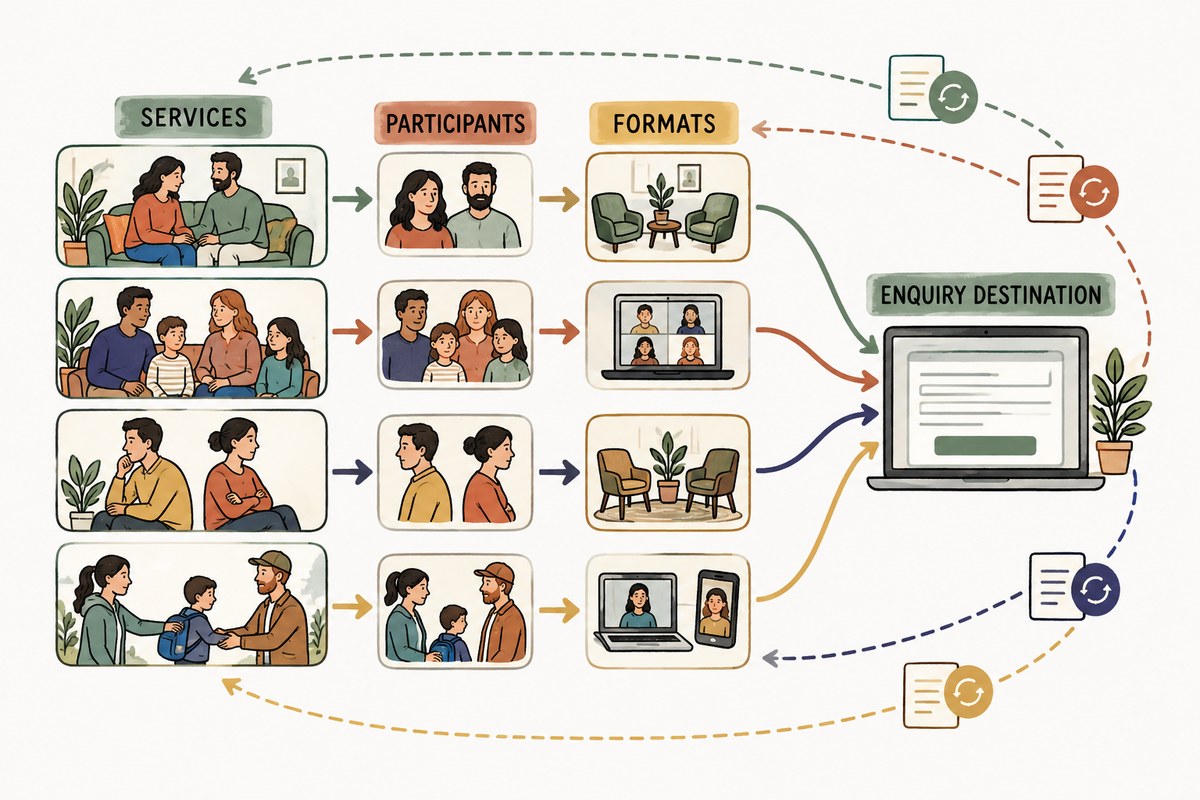
Session formats add another layer. Online, in person, hybrid, consultation, and group arrangements may have different availability or preparation. If the format affects who can attend, where the session happens, or how someone begins, the site should say so near the relevant service. Otherwise the owner may answer the same avoidable question repeatedly.
Finally, decide where intake belongs. The website may provide context and direct the visitor to an external system. It may also contain a simple enquiry route whose purpose is only to start contact. Do not assume that a website form is appropriate for sensitive clinical details. Confirm the destination, its intended use, and the practice’s own professional requirements before choosing the form. A form built to collect health information on a covered host adds $600 to $1,400 to a freelancer build, and the same source advises keeping the website form to basic contact details and moving intake into the practice system (Project Cost Estimator, June 2026).
For the route pricing behind this comparison, see the therapist website cost guide.
This is why two sites with the same number of pages can have very different costs. One may repeat a stable description across a few pages. Another may need distinct service content, shared enquiry logic, clinician details, format information, and regular updates. The structure creates the work, and the work creates the cost.
A poor route creates expensive confusion
Choosing the wrong route rarely fails because the homepage looks unattractive. It fails because the website cannot keep the practice’s distinctions clear. A generic therapy page may leave visitors unsure whether the therapist works with couples, families, discernment questions, or co parenting concerns. The owner then pays in explanation time, edits, or lost fit. What the site must do before someone books is covered in the therapy website booking guide.
A weak enquiry path creates a second problem. A message may arrive without enough context to identify whether the person is asking for couples work, family work, or something else. That does not mean the site should collect every sensitive detail. It means the practice should decide what useful first context belongs in the enquiry and what belongs later in the appropriate system.
Unclear session formats create practical friction too. A visitor may not know whether both partners need to attend, whether family sessions are online, whether consultation differs from therapy, or whether a certain service begins with a call. If the site does not answer those questions, the therapist becomes the bridge between an unclear page and a real appointment.
Accuracy is another cost. Fees, openings, clinician availability, accepted arrangements, and starting instructions change. When those details appear in several places, a site that seemed inexpensive at launch can become a repeated checking task. A route is expensive when it makes ordinary updates difficult, even if the original invoice was modest.
There is also a boundary around information collection. A polished form can still be the wrong place for detailed relationship or clinical information. The useful planning question is not whether a form looks professional. It is whether the practice has deliberately chosen the destination, fields, access, and follow up process for what it asks people to share.
The consequence of a poor route is not always dramatic. More often, it is a quiet accumulation of mismatched enquiries, repeated clarifications, stale service details, and pages that no longer agree. That is why maintenance belongs in the original cost comparison. The owner is buying an operating arrangement, not only a launch date.
Use this practice structure test
Begin by listing every service that deserves its own explanation. If one short page can accurately describe the practice, a DIY builder or freelancer may be sensible. If couples therapy, family therapy, discernment counseling, co parenting work, and individual support each have different questions or next steps, the site needs a more deliberate content structure.
Next, list the people involved. One clinician with one enquiry destination is simpler than several clinicians with different availability or specialties. A small group practice may still be straightforward if everyone follows the same process. It becomes more involved when each person needs distinct service pages, scheduling instructions, or ownership of updates.
Then mark any custom system need. Do you need a connection that is not available through ordinary tools? Does the enquiry need to reach different people based on service or clinician? Is there an unusual scheduling or handoff process? If yes, ask an agency or experienced freelancer to scope that workflow. If no, do not pay for custom work simply because it sounds more professional.
Assess your tolerance for upkeep honestly. Are fees, hours, clinician openings, or service descriptions likely to change? Will you make those edits yourself? Do you want to review a dashboard, or would you rather send a clear request to someone else? A route that matches your maintenance habits is usually a better value than one chosen only for its launch price.
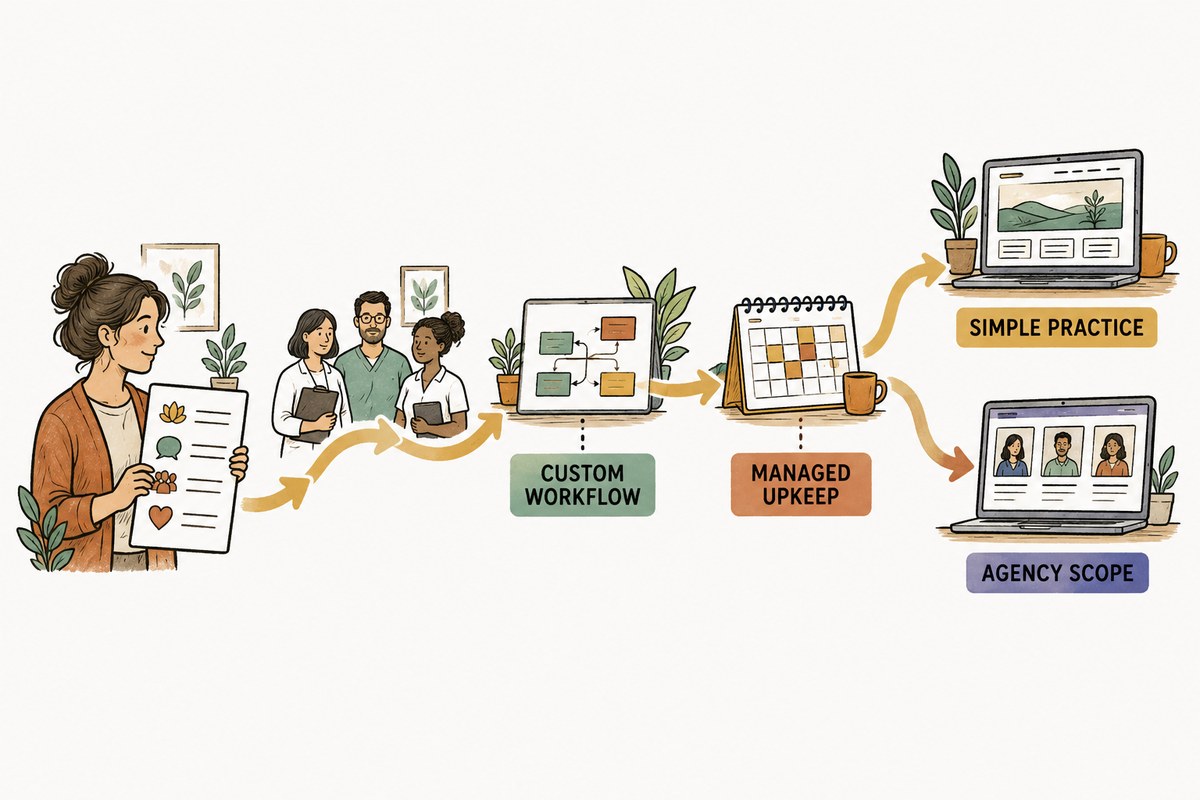
Clarify ownership before signing. Ask who owns the domain, content, accounts, design files, and the right to make ordinary edits. Ask what happens when a clinician joins or leaves, when a service changes, or when the practice moves its intake destination. Ownership is not a technical detail. It determines how freely the practice can respond to change.
For neighboring decisions in the same cluster, the counselor website cost guide covers practice shapes, the psychologist website cost guide covers the assessment side, and the therapist builder comparison covers the builder route.
Finally, identify where the first enquiry should land and how often the related pages need review. A simple practice with stable information can choose DIY or a freelancer with confidence. A practice with several services, clinicians, destinations, and frequent updates should consider a managed route or a custom build, depending on its systems and control requirements.
Match upkeep to practice complexity
The decision rule is simple: choose the least involved route that can represent the practice accurately and support its real enquiry path. Least involved does not mean cheapest at launch. It means no more structure, technical work, or ongoing responsibility than the practice genuinely needs.
Choose DIY when the service list is short, the practice is comfortable making edits, and the first enquiry already has a suitable destination. Choose a freelancer when the message and service structure need expert help but the workflow is ordinary. In both cases, agree in advance who maintains fees, availability, formats, and intake instructions.
Choose an agency when custom integrations, multiple pathways, or unusual clinical and administrative workflows justify a project built around those requirements. An agency is not automatically better for a small practice. It is better when the practice needs a level of integration or control that a lighter route cannot honestly provide.
Choose a managed route when the main problem is not unusual functionality but the burden of keeping the website accurate. Mirin’s public platform and small business pages describe a route for owners who want the website handled, while its pricing page provides the current commercial details. Review those details against your service inventory before deciding.
If your practice points toward a managed route, bring that inventory into a pricing conversation: services, participants, clinicians, session formats, enquiry destination, and likely updates. That produces a more useful fit check than asking for a generic therapist website. If your needs point elsewhere, choose the freelancer, agency, or builder that matches them and do not buy management you will not use.
For the operating model behind that work, explore how Mirin plans, builds, and maintains websites.
A good website cost is the cost of a structure you can keep truthful. For a relationship based practice, that means visitors can recognize the kind of support offered, understand who the service involves, see how sessions work, and take an appropriate first step. The route is right when the practice can sustain that clarity after launch.

