
A handyman website costs $1,750 to $5,800 from a freelancer in 2026, or $4,350 to $13,800 from an agency, on Project Cost Estimator's handyman estimate for the year. A done for you subscription changes the shape: web designers who publish prices for handyman sites charge $0 to $399 to start with $29 to $189 a month, or $499 to $2,750 and up for a one time build. The first invoice is one of three lines you pay.
Published ranges move with your town count, your page count, and how much finished work photography you already have. Treat every number below as the shape of a purchase rather than a budget, and ask each vendor for a written scope before you compare prices. A number without a scope tells you very little about the website you will actually receive.
Mirin's public service overview describes the handled website model behind this advice: read the overview.
What a Handyman Website Costs in 2026
There are four common ways to buy a handyman website. You can build it yourself on a site builder, pay a monthly provider to handle the site for you, hire a freelancer for a one time fee, or commission an agency for a larger one time project. Each route moves cost between three lines: the launch work, the recurring charges, and the price of changes after launch.
Before any of that, a handyman website is a scope document. The word handyman means something different to every homeowner, so the site's first job is to name the jobs you take, the jobs you pass to a licensed trade, how you charge, and the towns you drive to. That is also what makes it different from a contractor website, which sells one large project. A handyman site sells trust for small jobs inside someone's home and a visit that happens soon, and the contractor website cost guide covers the larger version of the same decision.
The three lines are where handyman websites get expensive in ways the quote never shows. A job you no longer take removed from the list, a town page added when you start driving further, a quote form changed when you begin asking for photos: somebody does that work, and the route you pick decides who.
What the Published 2026 Prices Show
Four published sources cover the routes between them, and their numbers describe the same market shape.
- Builder, built by you: $16 to $49 a month for the builder plan, plus your own evenings.
- Done for you subscription: $0 to $399 up front plus $29 to $189 a month at handyman only providers, or from $297 a month at a home services agency on a 12 month minimum.
- Freelancer, one time build: $1,750 to $5,800, with a services list, quote form and photo gallery landing near $3,750.
- Agency, one time build: $4,350 to $13,800, about 2.3 times the freelancer band for the same scope.
The freelancer and agency bands come from Project Cost Estimator's handyman website cost estimate for 2026, which also puts a typical build at 2 to 6 weeks and monthly running costs at $30 to $120 a month. The subscription prices come from Zarla's reading of what web designers publish for handyman sites, checked October 8, 2026. The builder plan band comes from FlatFeeWeb's 2026 handyman price guide, which also lists freelancer market ranges at $500 to $3,000 and full service agencies at $5,000 to $30,000 and up. For the general market view across every trade, the small business website cost guide lays the same routes side by side.
Scope moves the quote more than the vendor does. Project Cost Estimator puts online booking at $300 to $800 and a network of eight to twelve town pages at $300 to $900. Zarla's table shows a small studio at $499 for one page and from $2,499 for more, with a care plan of $39 to $149 a month on top. ClickBuilt, updated November 11, 2026, prints one time builds at $999 for up to 15 pages, $2,999 for up to 40 and $4,999 for up to 200, and says most one person handyman businesses fit the $999 build. When two honest sources land in different places, the scope behind the number is the difference.
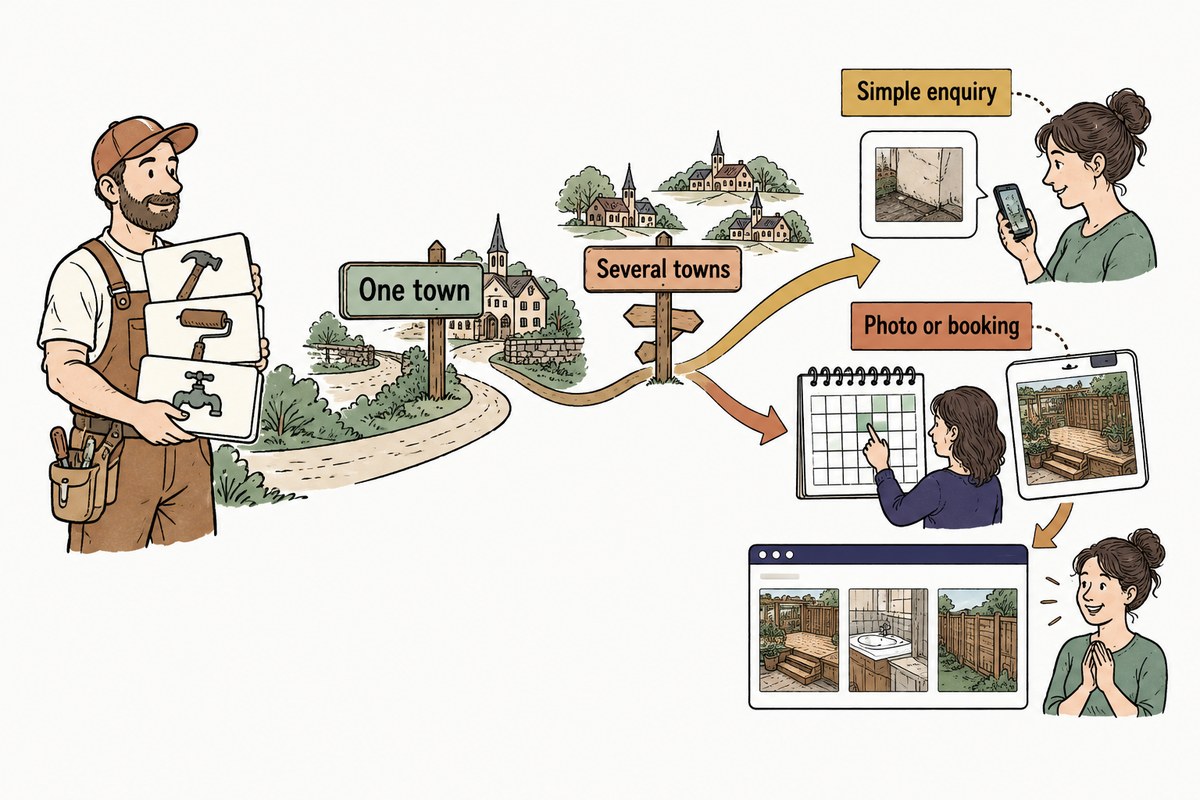
The figure shows the moment a quote grows. One town and a simple enquiry sit at the bottom of every band. Several towns, photo requests, booking and a gallery of finished work are the levers, and each one is worth paying for only when it changes how a customer hires you.
For handyman work the trust happens at the doorway, so the money tends to go where the proof is: real photos of finished small jobs, reviews in the first screen, and a license and insurance line that matches what you hold. Whatever route you buy, those are the parts to protect.
The Five Minute Diagnosis
You can diagnose the right level of website in five minutes. Write down the jobs you actually take, the towns you serve, the way you prefer a customer to reach you, and what someone must send before you can judge a job. Then compare that list with your current website or with the scope written into a quote.
Start with geography. One town may need one clear service page and a number that dials in one tap. Several towns need pages that name where you actually drive, not a radius on a map. Next check the enquiry. A simple contact form is enough when you can qualify work on the phone. A photo based quote request matters when the picture decides whether you take the job, and FlatFeeWeb calls that form the piece that replaces a drive out estimate on most requests. Booking matters when the appointment is genuinely repeatable. A gallery matters when finished work carries the trust.
Finally, count updates rather than features. Will you remove jobs you no longer take, add a town, replace old project photos, or change the first question on the form? A feature belongs in the quote when it creates setup work. It should not become a permanent fee without a clear reason.
Then think in two columns. The first is money paid to launch and keep the site available. The second is work you still do after launch, and the cheapest route in cash can cost the most attention. The deciding question is who can keep the site accurate when your job list, towns, photos or quote process change.
Who Keeps a Handyman Website Current
Price tables hide the trade that matters most for a handyman. The job list is the product, and it moves all the time: you drop the jobs you no longer want, add the ones customers keep asking for, and pass along the work your license does not cover, since the rules for handyman work vary by state, city and county and by the size of the job. A website that promises no job too small brings exactly those calls, so the list is worth editing, and somebody has to edit it.
Then come the towns, the photos and the form. A town you start serving needs a page with a name on it. A finished job photo is proof only when a caption says what was there before. A quote form that asks the wrong question quietly costs you estimates. None of this is launch work. It is ownership work, and the route you pick decides whether it lands on your evenings or on someone else's.
The lower the launch price, the more of that work usually stays with you. A builder site hands you the editing. A one time project hands you a finished object and a support boundary. A monthly service should hand you neither, but the contract decides, so read what the monthly fee actually includes before you sign.
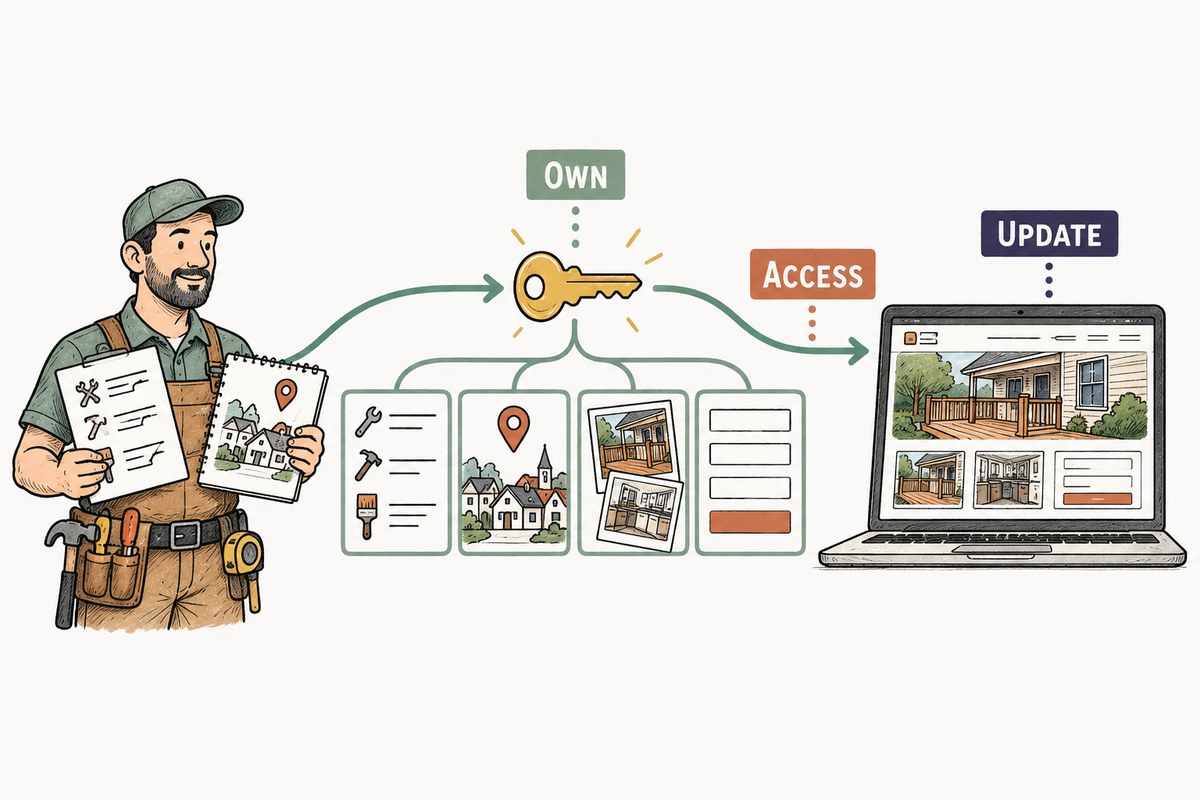
The figure shows what ownership means in practice. The domain, the account, the files, the form data and the photos are the parts your business depends on, and the access to them should sit with you whichever route you choose.
Other trades make the same decision with their own proof to carry: the painter website cost guide is built around before and after photos, and the landscaping website cost guide covers the seasonal version of the upkeep question. Salons and med spas price the same four routes in the salon website cost guide and the med spa website cost guide.
When you would rather spend the day on jobs than on publishing photos and town pages, the handled route is the honest fit, and Mirin's model assumes this work never stops. When you enjoy the editing and have the time for it, the builder route is a real choice, not a lesser one.
Questions to Ask Before You Sign
Whatever route you are leaning toward, ask the same questions of every vendor:
- What does the launch price include: page count, writing, photo preparation, forms and search setup?
- Who owns the domain, the content, the photos and the form data afterward?
- What does one change cost after launch, and how fast do ordinary edits happen?
- Do new town pages or new service pages cost extra?
- What does a monthly fee include beyond hosting?
- What happens to the website if you cancel?
Write the answers on one page with your job list and your towns at the top. Then every quote you collect prices the same website, the cheapest number stops being the easiest one to misread, and the route you pick is the one whose updates you can actually keep up with.