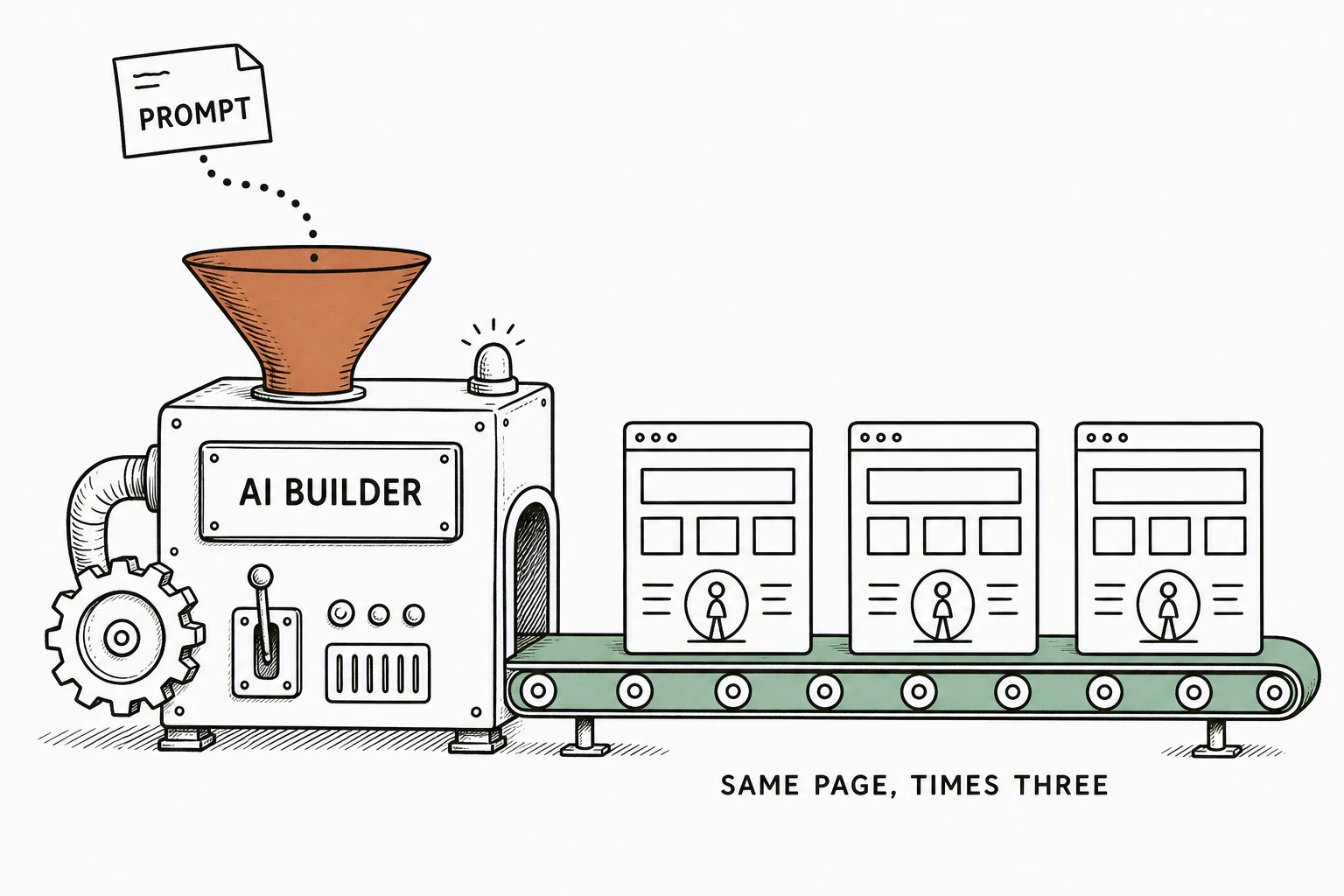
The problem with AI website builders is not the AI, it is the sameness. They produce a page astonishingly fast, and that page looks and reads like everyone else's, which is the one thing a website cannot afford to be. Speed to launch is real, but speed to a site that actually converts is a different thing, and that is where the generic output quietly costs you.
An AI website builder will give you something live in an afternoon. That feels like a win, and in one narrow way it is.
The trouble starts the moment a real visitor lands on it. They have seen this hero before. The same centered headline, the same three-column feature grid, the same stock founder standing with folded arms. Nothing on the page tells them why you, and so nothing on the page asks them to act.
Want to see how your current site scores on the parts that actually make someone act? Run it through the free Mirin scorecard. Sixty seconds, no signup.
Fast in, identical out
Why AI website builders feel great and convert poorly
AI website builders feel great because they remove the blank page, and they convert poorly because they remove the specifics that made you worth choosing.
A language model builds from the average of everything it has seen. Ask it for a homepage and it returns the most probable homepage, which is by definition the most common one. That is exactly what you do not want. Your visitor is deciding in seconds, and the decision is almost entirely visual. The Stanford Web Credibility research led by B.J. Fogg found that 75% of people judge a company's credibility based on its website design. When the design is the same one they saw on three other sites this week, the credibility it borrows is nobody's.
To be fair, the AI is not the villain here. We use AI at Mirin every day, and it is very good at the parts of website work that are genuinely repetitive. The problem is not intelligence. It is what an unguided model optimizes for, which is plausibility, not persuasion. A plausible page and a page that gets someone to book are not the same page.
As Steve Jobs put it, "Design is not just what it looks like and feels like. Design is how it works." An AI builder is very good at the first half and blind to the second.
What the generic page actually costs you
A generic page costs you the two things a small business site exists to earn, trust and the next step.
Trust goes first. When your headline could belong to any business in your category, a visitor has no reason to believe you understand their specific problem. Reviews and specifics are what rebuild that trust, and generic pages tend to bury both. BrightLocal's consumer research found that a large majority of consumers will only use a business rated four stars or higher, yet the average AI first draft rarely surfaces a single real testimonial, because the model does not know your reviews exist.
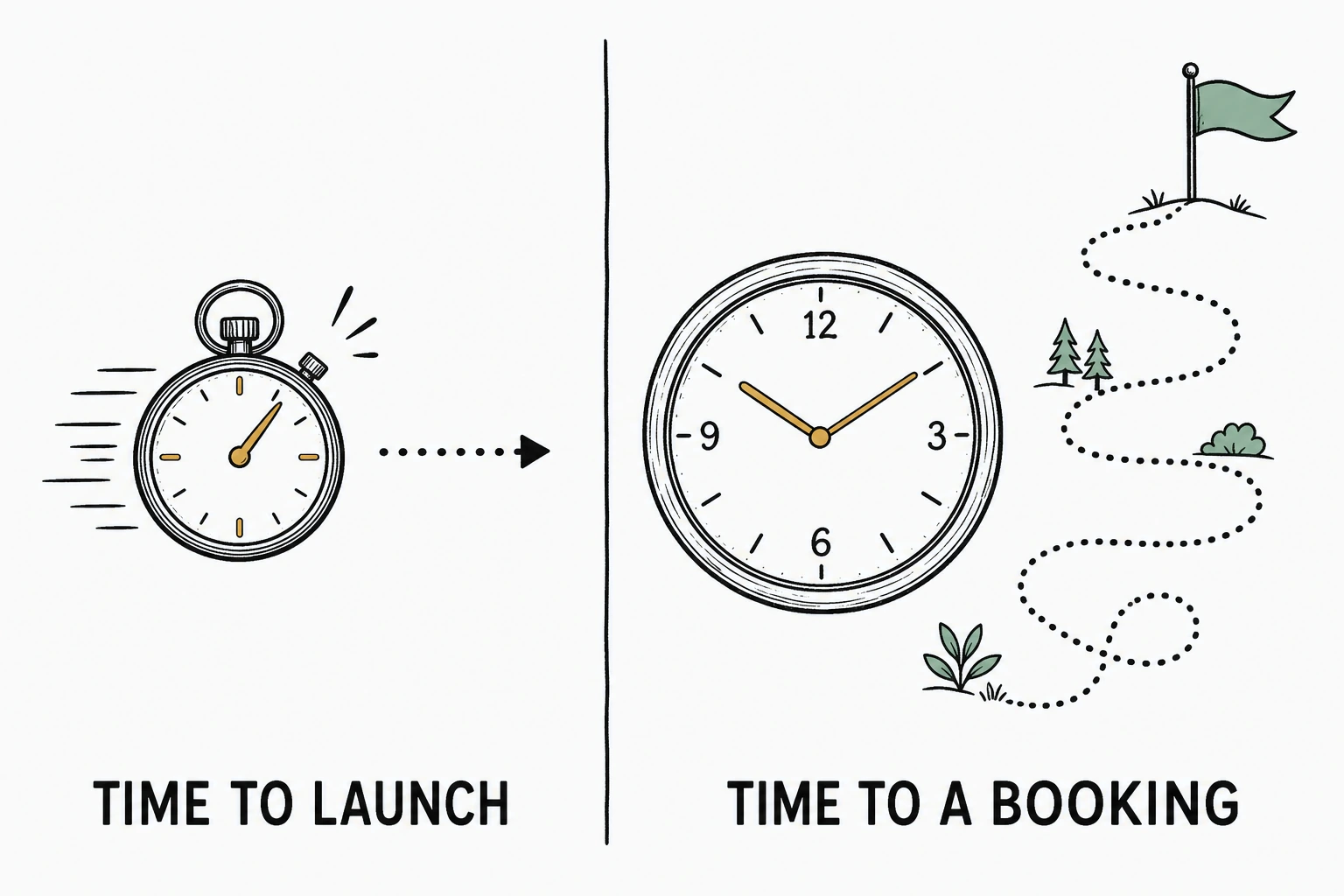
The next step goes second. Speed compounds the loss. AI builders love a busy layout, and busy is heavy. Google's mobile benchmarks show that as a page load moves from one second to three, the probability of a bounce rises 32%. Since the majority of web traffic is now on mobile, a template that dazzles on your laptop can be silently losing the booking on a phone.
Two clocks, one that matters
See where your site reads generic and where it is losing the next step.
Send Mirin your site. We grade it against the parts that make a visitor trust you and act, clear positioning, speed, and one obvious next step, and tell you what to fix first.
Run the free scorecard- Paste your site URL
- We grade it in seconds
- You see the gaps
- You decide
What we see when we rebuild sites an AI builder made
Across the sites we have rebuilt at Mirin, the AI generated ones almost always fail in the same three places, and none of them are hard to fix.
The headline names the category instead of the customer. The page shows a stock person instead of the real owner. And the whole thing offers four competing buttons instead of one clear next step. Fix those three and the page starts working, usually without touching the underlying tool at all. We have watched an owner swap a confident, specific headline in for the AI's safe one and see the first real inquiry arrive the same week. The lift was never more AI. It was a human deciding what mattered and cutting the rest.
That is the honest line on all of this. The fastest way to a bad website is to accept the average the model hands you. The fastest way to a good one is to let the machine do the heavy lifting and let a person make the calls only you can make, who you help, why you, and what you want them to do next.
How to use an AI website builder well
Use an AI builder for the scaffolding and never for the judgment, and you get the speed without the sameness.
Let it draft the structure, the boilerplate, the first pass at copy. Then override every generic default with something true. Replace the category headline with a sentence only your customer would recognize. Swap the stock photo for the real one. Cut three buttons down to one. Add the two reviews the model never knew you had. That short list of human edits is the entire difference between a page that looks fine and a page that books.
If you would rather not do that editing yourself, that is the whole reason a handled approach exists. A done for you service uses the same AI speed under the hood, then puts a person on the judgment calls and keeps the page current as your business changes. If budget is the real question underneath this one, here is how much a professional website actually costs across every path, and if you are weighing tools, here is an honest look at the best website builders matched to who you are.
Done right, the handled version folds the AI speed and the human judgment into one line, so the fast page is also the specific one that keeps converting as you grow. See how that works on Mirin pricing.
See your site rebuilt to read like you, not like everyone.
Send Mirin your current site. We will shape a free preview that keeps the AI speed and adds the specifics that make a visitor trust you and act, so you can compare it to whatever you have now.
Get my preview- Send your current site
- We shape a preview
- You compare it to your site
- You decide, live in days
The repeatable rule: the problem with AI website builders is not the AI, it is accepting the average it hands you. Keep the speed, override the generic defaults with what only you know, and the fast page becomes the one that actually converts.